 how-to
Why Your AC Keeps Tripping the Breaker: 2026 Guide
Table of Contents
- Why Your AC Keeps Tripping the Breaker: A Safety-First Decision Tree
- What to Do When Your AC Breaker Trips
- Air Conditioner Trips Breaker Immediately: What That Timing Tells You
- AC Trips Breaker After a Few Minutes: The Delayed-Trip Causes
- Air Conditioner Breaker Won't Reset: What It Means and What to Do
- HVAC Faults vs. Electrical Panel Problems: How to Tell the Difference
- Preventing a Tripping AC Breaker: Maintenance That Makes a Difference
- Conclusion: When to Call a Professional for a Tripping AC Breaker
- Frequently Asked Questions
Last Updated: October 5, 2026
Why Your AC Keeps Tripping the Breaker: A Safety-First Decision Tree
An AC tripping breaker is your home's electrical system doing its job: it cuts power before heat or current turns a small fault into a fire, and an AC tripping breaker is a warning you should never ignore.
So why does your AC keep tripping the breaker? The breaker is the messenger, not the problem. The real cause sits somewhere between the air filter and the compressor.
Here's the honest part most guides skip: resetting the breaker over and over is the actual danger, and every reset pushes a stressed circuit closer to failure. Below is a decision tree for what's safe to check, what to leave alone, and when to call a licensed HVAC technician.
When to Stop Resetting and Call for Help
Stop and call a professional the moment you see or smell any of these:
- A burning smell near the panel or outdoor unit
- Scorch marks, melted plastic, or discoloration on the breaker
- A breaker that feels hot to the touch
Any one of these points to an electrical fault, not a maintenance issue. This is electrician and HVAC territory, not a DIY project. The U.S. Consumer Product Safety Commission home electrical safety guidance is clear that overloaded and faulty circuits are a leading cause of home electrical fires, and a breaker that keeps tripping is exactly that warning sign.
What to Do When Your AC Breaker Trips
When your AC breaker trips, follow these steps in order. Do not skip ahead.
- Turn the thermostat to OFF so the system won't restart the moment power returns.
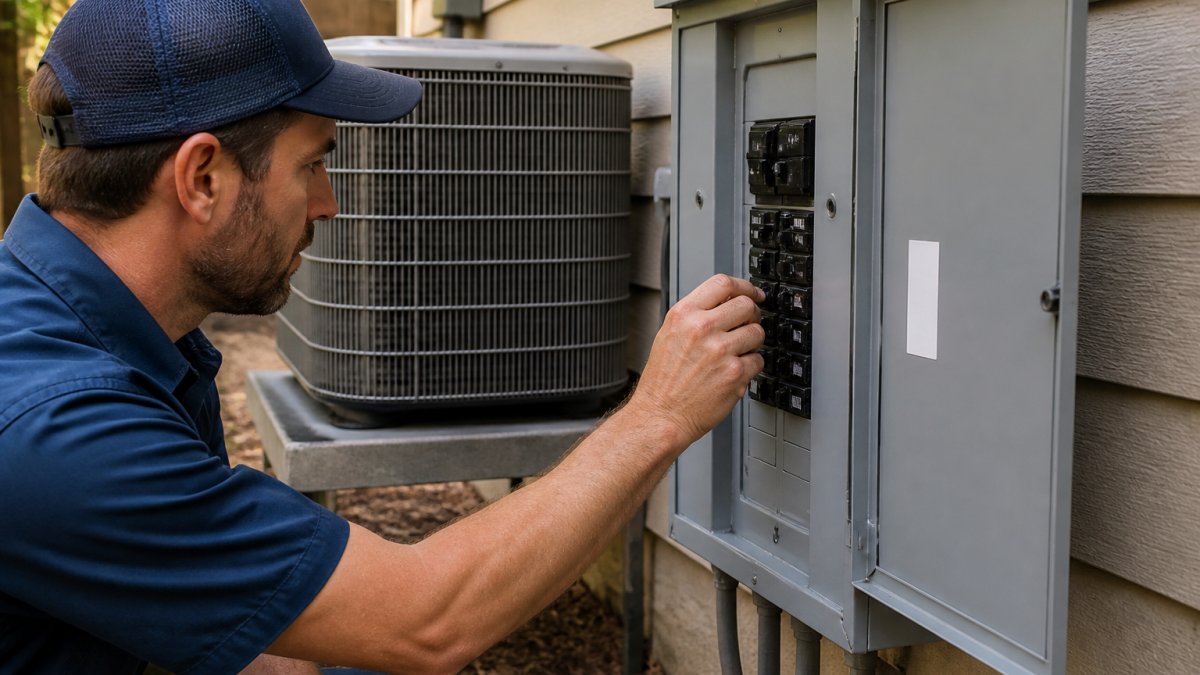
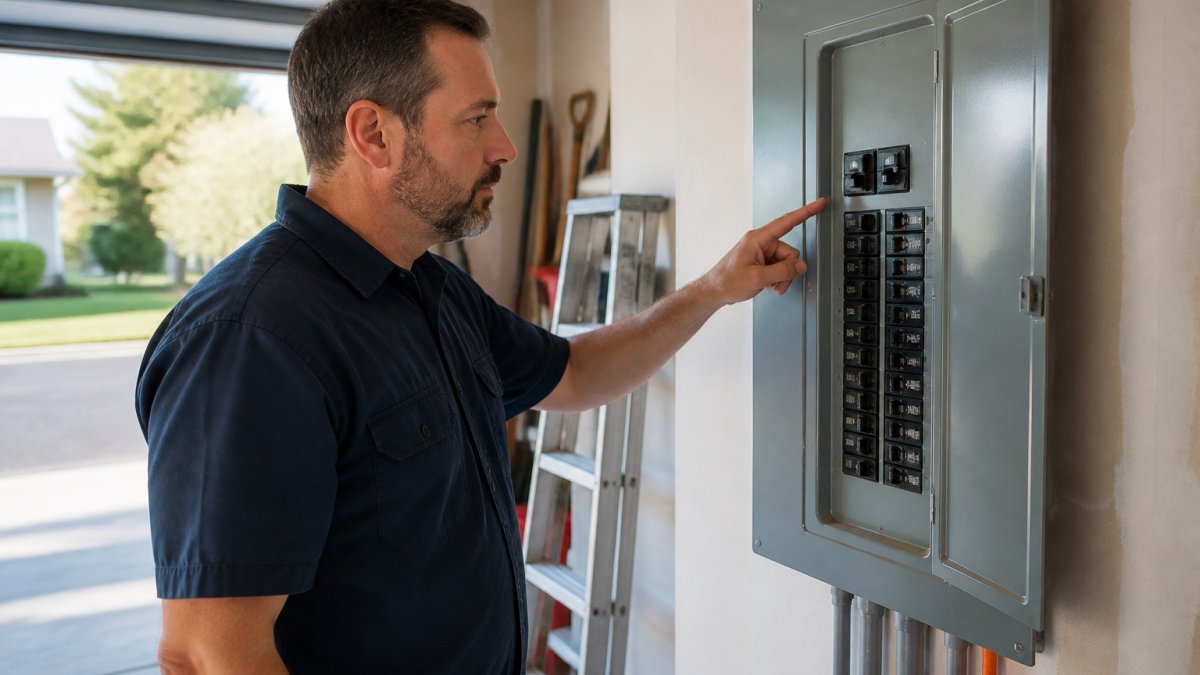
- Find the breaker in your main panel. It's usually a double-pole switch labeled "AC" or "Air Conditioner."
- Look at the switch. If it sits in the middle, it tripped. Push it fully to OFF first.
- Wait 30 minutes. This lets the compressor cool and equalize pressure.
- Flip the breaker firmly to ON.
- Watch the outdoor unit. If it runs normally, note the time. If it trips again, stop here.
If it holds, you may have caught a one-time event like a brownout or heat spike. If it trips again, the timing of that second trip is your best clue.
Air Conditioner Trips Breaker Immediately: What That Timing Tells You
An air conditioner that trips the breaker immediately has a hard electrical fault: the breaker reacts to a sudden surge or dead short in the first seconds of startup, not to heat buildup or a slow overload.
The usual suspects:
- Short circuit in the wiring. Two conductors touch, and current jumps the gap. This is a genuine electrical fault.
- Grounded compressor. The compressor's internal windings fail and contact the metal housing.
- Failed capacitor. A bad capacitor can't give the compressor the jolt it needs, so it draws a huge startup surge instead.
Here's the split that matters. A grounded compressor or a shorted wire is an electrical fault. A weak capacitor is a component fault. Both trip the breaker instantly, but only one is cheap to fix.
AC Trips Breaker After a Few Minutes: The Delayed-Trip Causes
An AC that trips the breaker after a few minutes is almost always an overheating problem: the system runs, current climbs, heat builds, and the breaker's thermal element gives out.
The leading causes:
- Dirty air filter. A clogged filter chokes airflow, so the blower motor works harder and pulls more current.
- Dirty condenser coils. Dust and dirt on the outdoor coil trap heat, forcing the compressor to run hotter and longer.
- Restricted airflow. Blocked vents, closed registers, or a failing blower motor all raise the electrical load.
Notice the theme: heat and airflow. Most delayed trips trace back to maintenance the homeowner can control. Clean the filter, clear the coils, and open the vents. If the trip continues, the fault is inside the unit.
How Trip Timing Narrows the Cause
"After a few minutes" is a wide window. Tighten it, and the likely fault category shrinks fast. Use the pattern below to describe what you're seeing, not to open the panel.
| When it trips | What's building | Most likely category |
|---|---|---|
| 30 seconds to 2 minutes | Startup surge, no time for heat | Capacitor, hard-start components, compressor windings |
| 3 to 10 minutes | Thermal buildup at the breaker | Filter, airflow, blower motor amp draw |
| 10 to 30 minutes | Sustained high current | Condenser coil heat rejection, refrigerant charge, compressor wear |
| Only on the hottest afternoons | Circuit at its ceiling | Undersized breaker or circuit, shared load, voltage sag |
| Random, no pattern | Intermittent connection | Loose terminal, failing breaker, wiring fault |
A trip in the 3-to-10-minute band that disappears after a filter change is a maintenance story. A trip in the 30-second band that repeats no matter what is an electrical story.
What You Can Safely Check Before Calling
These checks are bounded on purpose: no panel work, no meter, no live electrical testing.
- The filter. Pull it and hold it up to a light. If you can't see through it, that alone can explain a delayed trip. Replace or clean it and retest.
- The thermostat setting. Confirm it's set to COOL and the fan is on AUTO, not ON. Continuous fan mode runs the blower nonstop and adds load.
- The outdoor unit. With the system off at the thermostat, look for leaves, grass clippings, or a cover left on. Clear debris and confirm at least two feet of clearance on all sides.
- The vents. Walk the house and confirm no supply or return register is blocked by furniture, rugs, or a closed damper.
- The return air path. A return grille blocked by a couch or a closed door to the mechanical closet starves the system and raises blower amp draw.
If a filter change or cleared coil stops the trip, you've solved it. If it returns within a day, stop resetting and call, a technician can measure amp draw, check the capacitor, and confirm the breaker rating against the nameplate, none of which is safe to do at home.
Why "A Few Minutes" Is the Most Fixable Pattern
A delayed trip means the breaker is responding to heat, not a dead short. Heat-based trips usually trace to load, airflow, or a degrading component, all diagnosable and usually repairable without replacing the system. The exception is a compressor drawing high amps because it's failing internally, which is why the amp-draw reading matters: it separates a $150 airflow fix from a compressor decision.
Air Conditioner Breaker Won't Reset: What It Means and What to Do
An air conditioner breaker that won't reset means the fault is still live. The breaker is doing exactly what it should: refusing to send power into a circuit that will fail again.
A breaker that won't stay on usually means one of three things:
- A persistent short or ground fault is still present in the circuit.
- The breaker itself has failed and can no longer hold its rated position.
- The breaker is undersized for the unit's actual power draw, so it trips the moment load returns.
That last one deserves attention. The U.S. Department of Energy cooling system maintenance guidance notes that mismatched equipment and poor airflow both drive up energy use and strain, which is exactly the kind of mismatch we look for.
HVAC Faults vs. Electrical Panel Problems: How to Tell the Difference
Separating an HVAC fault from a panel problem saves you money, because it tells you who to call. An HVAC technician fixes the unit. A licensed electrician fixes the panel and circuit.
Use this table to sort it out:
| Symptom | Likely Source | Who to Call |
|---|---|---|
| Breaker trips only when AC runs | HVAC unit or its wiring | HVAC technician |
| Other breakers trip too | Panel or main service | Licensed electrician |
| Breaker is warm or discolored | Breaker or connection | Licensed electrician |
| Trips after minutes of running | Airflow, coils, compressor | HVAC technician |
| Trips instantly every time | Short, ground fault, capacitor | HVAC technician first |
| Lights dim when AC starts | Circuit capacity or panel | Licensed electrician |
The tell is scope. If the problem stays with the AC circuit, it's an HVAC fault. If it spreads to other circuits, dims your lights, or involves a hot panel, it's a panel or service problem.
Preventing a Tripping AC Breaker: Maintenance That Makes a Difference
Most breaker trips we see are preventable. A short maintenance routine keeps current draw low and airflow high, which is the whole game.
- Change or clean the air filter every 1-3 months, more often with pets or heavy dust.
- Hose down the condenser coils each spring, and clear debris from around the outdoor unit.
- Keep two feet of clearance around the outdoor unit so it can shed heat.
The U.S. Environmental Protection Agency ENERGY STAR maintenance guidance recommends regular filter changes and annual professional tune-ups to keep cooling systems running at their rated efficiency. A unit that runs efficiently draws less current. Less current means fewer trips.
What Repairs Actually Cost, and What Moves the Number
Most guides stop at "call a pro," leaving the real question unanswered: what does this look like on an invoice? Pricing varies by market, system size, and access. For current pricing, please reach out to us directly for a quote.
| Likely fix | Typical range | What drives the price |
|---|---|---|
| Filter replacement (DIY or service call) | $10-$40 in parts | Filter size, MERV rating, whether it's a service visit |
| Condenser coil cleaning | $100-$400 | Coil accessibility, single vs. two-story, level of buildup |
| Capacitor replacement | $150-$400 | Part cost is low; labor and diagnostic time dominate |
| Blower motor replacement | $400-$900 | Motor type (PSC vs. ECM), access, warranty coverage |
| Contactor or relay replacement | $150-$350 | Part cost, panel access, whether wiring needs repair |
| Breaker replacement (electrician) | $150-$500 | Panel type, breaker availability, permit requirements |
| Compressor replacement | $1,200-$2,500 | Refrigerant type, warranty, whether lines need flushing |
| Full system replacement | $5,000-$12,000+ | Tonnage, efficiency tier, ductwork condition, labor market |
Three things move these numbers most:
- Diagnostic time. A technician who has to hunt for the fault bills more hours than one who arrives with a clear symptom history. That's why the trip-timing notes above matter.
- Parts availability. A common capacitor is a same-day fix. A discontinued ECM blower motor can add days and dollars.
- Warranty status. If the unit is under a manufacturer's parts warranty, the part may be covered while labor is not. Ask before authorizing work.
The Recurrence Question: Will It Trip Again?
A maintenance fix, filter, coil, airflow, usually ends the problem for the season. A component fix, capacitor, contactor, blower motor, ends it until the next component ages out. A compressor or breaker fix is longer-term, but only if the underlying cause was correctly identified; replace a capacitor without checking why it failed, and the new one can fail the same way.
That's the argument for annual service over reactive repair.
When Prevention Isn't Enough
If you've kept up with filters, cleared the coils, and confirmed airflow, and the breaker still trips, the problem is no longer maintenance, it's a component or electrical fault, and no amount of cleaning will fix it. The right move is a diagnostic visit, not another reset or another filter.
Conclusion: When to Call a Professional for a Tripping AC Breaker
A tripping breaker is a symptom, not a sentence. Sometimes it's a dirty filter you can swap in five minutes. Sometimes it's a grounded compressor that needs a real diagnosis.
What you should never do is keep resetting a breaker that keeps tripping. That's how a small fault becomes an expensive one.
At Morgan Home Services, we've spent over 20 years helping homeowners and property managers in Bushnell, Ocala, and the surrounding areas sort out exactly these problems. And when your AC quits in the middle of a summer afternoon, we treat it like the emergency it is.
If your AC keeps tripping the breaker, don't gamble with the reset switch.
Frequently Asked Questions
How do I stop my AC from tripping the breaker?
Start by checking the air filter and replacing it if it is clogged, since restricted airflow is a common cause. Then inspect the outdoor condenser coils for dust and dirt buildup. If the breaker still trips after a reset, stop resetting it and call a licensed HVAC technician. Repeated tripping points to an electrical fault, a failing capacitor, or a compressor problem that needs professional diagnosis. Morgan Home Services offers emergency service for these situations.
Is it safe to keep resetting an AC breaker that keeps tripping?
No. Repeatedly resetting a breaker that trips immediately or within minutes can overheat the wiring and create a fire risk. A breaker trips to protect the circuit from overload or a short circuit. If it trips more than once, leave it off and have the system inspected. The underlying issue, whether a loose wire, a grounded compressor, or an undersized breaker, will not fix itself and can worsen with each reset attempt.
Can a dirty air filter cause an AC breaker to trip?
Yes. A clogged air filter restricts airflow across the evaporator coil, which causes the blower motor to work harder and draw more current. That extra electrical load can eventually trip the breaker. Changing the filter every one to three months, depending on dust and pet hair, is one of the simplest preventive steps. If the breaker still trips after a fresh filter, the problem is likely elsewhere in the system.
When should I call an HVAC technician for a tripping AC breaker?
Call a technician if the breaker trips more than once, if it will not reset at all, if you smell burning near the panel or unit, or if you see scorch marks on the breaker. These signs point to short circuits, loose wiring, or a failing breaker that requires an electrician or HVAC professional. Morgan Home Services has over 20 years of experience diagnosing these issues and can provide an upfront estimate before any work begins.